Friday, August 19, 2016

Notre Dame's loose end

I wrote this long ago, deleted it when I applied to Notre Dame, and republished it today when a colleague mentioned the Manti Te'o story.

Deadspin reported Wednesday that former Notre Dame Heisman candidate Manti Te'o's tragic yet uplifting story involving his girlfriend Lennay Kekua's death and her previous existence was a hoax. If you keep up with any type of news, you already knew this. The story's development since Wednesday has led to speculation as to who was behind the hoax. 

Some think Te'o killed off his fake girlfriend on Sept. 12 to boost his Heisman status. Te'o said Friday that he began to receive phone calls from his fake, deceased girlfriend on Dec. 6 but continued to refer to her with the media because he was not convinced of the hoax until Deadspin broke the story this week. He also said that Ronaiah Tuiasosopo and two others were behind the mostly online hoax and apologized to him via, of course, Twitter. Deadspin reported that Te'o and Tuiasosopo had been friends.


This is all very confusing. Details will continue to emerge in the coming days that will clarify the participation of Te'o, Tuiasosopo and a couple others. What I fear is that Notre Dame's participation will be deemphasized or omitted.


ESPN and The Washington Post reported evidence that Notre Dame could be guilty of perpetuating what it knew to be a hoax. 

Dan Tudesco, a 2006 graduate who now works in public relations in New York, set up an online account at fundraising website indiegogo.com on Jan. 9 to solicit $5,000 for the Leukemia & Lymphoma Society Inc. The initial pitch said donations would go to the society in memory of Lennay Kekua, who reportedly died last fall, and in honor of Te’o, “two individuals who have been an inspiration to us through an iconic season.”
The story goes on to explain Notre Dame's support of Tudesco's effort.
Notre Dame took notice of Tudesco’s tweets about the fund drive and sent a university videographer to shoot an interview with him. The video was posted on the Notre Dame athletics YouTube channel Tuesday.
The Tuesday referred to is Tuesday, Jan. 15, which was one day before Deadspin broke its story. And here is the kicker.
However, Notre Dame officials said Wednesday that they became aware of the hoax on Dec. 26, nearly two weeks before the championship game.
Notre Dame said it did not announce the hoax on or after Dec. 26 because the Te'o family had expressed its own desire to do so once it had collected enough information from investigators. Fine. But 20 days after Dec. 26 it promoted a fund drive that had been started in memory of Kekua. The day after this promotion, Deadspin broke the story. Notre Dame's press conference immediately followed in which athletic director Jack Swarbrick did an excellent job of showing that Te'o was a victim and the university was a bystander.

It is true that the fund drive was also in honor of Te'o. Notre Dame certainly had an interest in showing support, in public and private, for its possibly victimized star. But was it really in Te'o's best interest to show support for a fund that perpetuated the very fabrication of which he was known to be a victim?


ESPN, The Washington Post and perhaps other outlets have posed this question, but Notre Dame has not yet answered it. Swarbrick did answer a related question at the press conference.

Reporter: The day of the national championship game when you guys had knowledge of this, there was a pre game special on the news morning show about his story. Did you guys know they were planning on doing that? Did you do anything to try to talk them out of that? How did you handle that situation? 
Swarbrick: Where did it air?
Reporter: I think it was a CBS morning show.
Swarbrick: I'm not familiar with it, so I guess the quick answer is since I didn't know it, I, we didn't -- We were very conscious of the fact that we didn't know what we didn't know. We recognized the challenge of that. If Manti got a question in a media session, you know, about that, how do you respond to that? We recognize the challenge of that and we weighed those difficulties against, on the other hand, these other issues that affected timing. I'll say one thing. When the investigation concluded, when we got the first report from the investigators, the one thing we were certain of is that this was coming out. There was too much online chatter about it. There was not an intention, a belief, anything that this would be a story that didn't get told. It was clear it would. We had hoped the first person to tell it would be Manti, and again, the expectation was that was going to happen next week. He didn't get that opportunity without someone else having told the story.
Later another reporter probed at a possible cover up.
Reporter: Did Notre Dame notify any law enforcement agency or the enforcement arm of the NCAA?
Swarbrick: No, there's no factual predicate for an NCAA violation that we could find. That of course was one of our important focuses early on. No, we did not refer this to criminal authorities. We shared, as I said, all of our information with the Te'os, who in turn shared it with their representatives to pursue it further.
Reporter: Considering at the very least somebody was harassing a star player for the university and potentially there could have been an extortion component to this . . . Why didn't Notre Dame contact law enforcement?
Swarbrick: We believed that was the victim's decision to make, and Manti was the victim here. He and his family in consultation with whomever they choose to consult with had that decision to make. We were not the victim. We've been impacted, but I don't want to confuse this at all. Manti Te'o was the victim of this scam.
Reporter: Was there a discussion about contacting law enforcement?
Swarbrick: Yes, there was a discussion of any response that might be appropriate.
Reporter: Do you still think that was the right decision, based on what's happened to this point? 
Swarbrick: I do.
You be the judge.

Sunday, December 6, 2015

An in-stadium perspective of the botched offside call at the ACC Championship

ADDENDUM: An earlier version of this post suggested that the ACC was incorrect in stating that offside on a kickoff is not reviewable. The ACC was actually correct in stating that offside on a kickoff is not reviewable. NCAA Rule 12, Article 4(b) reads:

Article 4: Reviewable plays involving kicks include: (b) Player beyond the neutral zone when kicking the ball.

The correct interpretation is that only the kicker's position can be reviewed. This would only apply to punts since a kicker can never be offside.

Yesterday the Tar Heels were robbed of a chance to send the ACC Championship game into overtime when a referee threw a flag for a recovered onside kick offside that never happened. Carolina would have trailed by eight with the ball at midfield, all three timeouts remaining and 1:11 to go. Carolina didn't play well enough to deserve to win, but I still don't feel like we lost. For me, the game will always feel unfinished.

Everyone in the world now knows that not a single Tar Heel was anywhere close to being offside on the play. Video replay would not have been necessary to reverse the call; a simple still shot with kicker Freeman Jones's foot on the ball was more than sufficient to show that the Heels were too slow, not too fast, to the line. We can speculate as to why the official threw the initial flag, but the ensuing three minutes were far more interesting than the initial call.

The Carolina coaching staff knew the flag was a mistake because it had the benefit of watching up in the booth the same replays you saw on television. Carolina Athletic Director Bubba Cunningham quickly asked a sideline official if the offside call was reviewable, and the official assured him that it was. That sideline official was incorrect. NCAA Rule 12, Article 4(b) states that reviewable plays involving kicks include determining whether a player is beyond the neutral zone when kicking the ball. Since the player in question was not kicking the ball, the play was not reviewable. Accordingly none of the officials reviewed the play to overturn the on-field flag, and Carolina kicked a second time without retaining possession.

But the most curious thing about this error didn't hit me until I was driving home from the airport this morning. Bank of America Stadium has two new 56' x 199' video boards that allow all 75,412 fans to comfortably view instant replays. The video boards had served this purpose all game and would show Clemson recovering the second and final onside kick to secure the win just a couple minutes after the mistaken offside call. However, the video boards did not show the sufficient replay of the mistaken offside call that you saw on your television. What we saw in the stadium was incomplete. The aggrieved yelling that normally accompanies a botched call never happened in the stadium for the offside call. In fact, I knew of the error in the stadium only because my friend's wife texted him what she was seeing on her television at home. The magnitude of the error clouded our ability to recognize this diverted flow of information.

I could speculate as to why the ESPN and in-stadium replays were so different, but I'll let you do that instead while I stick to the facts. Oh, the facts. Here's another one.

Clemson fans outnumbered Carolina fans by a ratio of roughly 5:1. Carolina had ordered its 5500 allotted tickets and 2500 extra tickets, but 8000 tickets could neither satisfy Carolina fans' demand nor fill anywhere near half of a 75,000-seat stadium.

Clemson fared much better since they clinched a berth in the championship weeks before Carolina did and gobbled up the general public ticket allotment before Carolina had the chance. Carolina clinched later through no fault of their own since they were undefeated in conference play. The ACC could do more to ensure a more balanced championship atmosphere.

Clemson was guaranteed a spot in the College Football Playoff with an ACC Championship win, but Carolina had only a decent shot at the CFP with a win. I hope this difference figured into neither the botched call nor the ticket allotments.

Moving forward, I wish Clemson the very best in the College Football Playoff.


Tuesday, May 5, 2015

Jane Eloise

On the morning of April 25, I rolled over in bed to grab my phone as I usually do and found my six-hour-old niece on the screen. She was wearing a winter hat and an enormous, adult-looking diaper. The accompanying text message: Jane Eloise. She looked beautiful and smart, a lot like my sister.

I had not had enough time to contemplate how I would feel about being an uncle because my second semester of business school was too busy for comfort. I wasn't worried. Mentally preparing to be an uncle takes only a few minutes. So I mentally prepared, albeit for a bit longer than a few minutes because my sister had led me to expect a nephew instead of a niece. Then my wife, visiting mother-in-law and I drove through three hours of ill-suited rain from South Bend to Evanston Hospital.

We worked our way through several layers of security before arriving outside my sister's room. My sister's husband, Tim, explained that we would have to wait while Jaylyn nursed Jane, so we patiently sat outside an empty nursery with Tim's parents. Nobody else was around. We appeared to be the maternity ward's only customers.

My dad appeared a moment later after mistakenly searching for us in the downstairs atrium.

"Jane blah blah blah blah," he said, "and Jane blah blah blah blah blah blah."

I was not uninterested in what he had to say about this new person, but I couldn't focus on anything he said other than her name. My brain immediately defaulted to Jaylyn's bridesmaid Jane, the namesake of the baby.

Apparently my niece was more than a nameless model in a diaper commercial or a perpetual balancing exercise for my pregnant sister. She had a name, and we were expected to use it. My original family had grown again to Mom, Dad, Jaylyn, Tim, Melissa, Winnie, Jane and I. Jane was a permanent +1, a brand new Christmas stocking coming to a fireplace near me, and I had not met her.

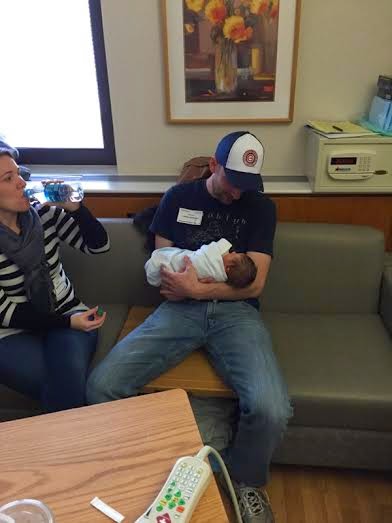
Minutes later Tim said our turn had come, so Melissa and her mom, my dad and I walked into the room. Jane was in my sister's lap, alternately staring at the ceiling and at her mom. She wasn't crying or uncomfortable with her new world in any way. Jane looked like she knew she was exactly where she was supposed to be. My sister smiled.

My dad and sister retold their stories from the past 12 hours, but I couldn't focus on them. I positioned myself by the head of the hospital bed so I could look at my beautiful niece and let her look at me. I hadn't shaved for a week and silently scolded myself for looking needlessly scary to an infant--if infants dislike facial hair as much as some dogs. Jane didn't seem to mind.

"Do you want to hold her?" Jaylyn asked.

"I don't know how," I said. "I know I'm supp-"

"Babies are resilient," she said. "Just hold her. You'll do fine."

So I put one hand behind her head and my other arm under her body. Then we looked at each other for what seemed like an hour. Jane was a person all her own, not quite her dad and not quite her mom. She had a lot of hair. She moved her mouth as if she was stretching her jaw. Sometimes she sneezed. Her eyes had a unique shape that reminded me of nobody I had ever met. She was gorgeous. I passed her to Melissa and took a few photographs.

-----

In the late spring of 2010, my mom called me at work. She told me she was at the hospital to have her blood drawn. She felt lethargic and somehow believed that her blood test results would come back with bad news. My mom had always been optimistic and healthy, but she sounded different that day on the phone. I was worried.

Hours later we were together at the hospital when an emergency room doctor told my mom she had acute myeloid leukemia. Another doctor was quick to tell us that the five-year survival rate was 50 percent, a rosy forecast compared to today's WebMD. My mom needed to start chemotherapy as quickly as possible.

With my dad and sister in Chicago, my mom and I hung together in North Carolina to take the early punches. We hoped for good news, but it was all bad. My mom asked me to call our family and her best friend. They all had a lot of questions, some of the same unanswered ones I had. I told everyone we were getting treatment as quickly as possible and learning new things every day. We couldn't know the exact, ultimate course of treatment until later.

Several doctors unloaded a lot of medical information on us in the following days. We learned about chemotherapy, AML, stem-cell transplants and the salient metrics from her past and future blood tests. One doctor said something that broke the mold of everything else we heard.

"Our goal is to get you through this in one way or another," he said, "because we want you to be around for a grandchild someday." He nodded in my direction.

Some readers must think I smooth the rough edges of blurry memories, and maybe I do. But I remember that moment well. My mom's moistened eyes darted in my direction, and one corner of her mouth mustered a sad smile. We said nothing. The moment passed.

My mom and I never talked about the things we wanted her to live for. I focused on her survival because the bounties of life, the big moments and the little pleasures we take for granted, would have overwhelmed me. My mathematics education had taught me to simplify, simplify. Or maybe I got that from her.

-----

She stepped off the elevator looking the happiest and healthiest I have ever seen her. Her hunched shoulders, hushed voice and wide eyes gave away her excited anticipation.

While I was unknowing and asleep, my mom had packed her bags in Chapel Hill for a 13-hour drive and indefinite stay in Chicago with her daughter, son-in-law and newborn granddaughter. She had left at 4 a.m. We would have called her with reports from the hospital to keep her awake, but my mom doesn't touch her phone when she drives. She had survived cancer with a stem-cell transplant from her sister. She doesn't take chances.

When we all walked in together, Jane wasn't on Jaylyn's lap. My mom's attention went straight to her daughter, and I think she momentarily forgot who else was in the room. Jaylyn pointed to the nearby bassinet, and my mom walked to it.

She looked and smiled at her granddaughter, Jane Eloise Stenta, for a long time. A week later she wrote:
When I looked at Jane, she was so tiny and real. I loved her so much, as much as I love you and Jaylyn. I never thought it was possible to love anyone else like that. I also thought what a perfect little miracle she was. I couldn't take my eyes off of her.
I do not know what my family did to deserve any of this. The last five years taught me that so much of life is out of our hands. Sometimes good things happen, and sometimes bad things happen. All we can do is let each other know that we love each other.

After all, Jane is only beginning to understand how much we love her. I'd better call my sister to tell her again.


Tuesday, January 6, 2015

Why Stuart Scott won

The last few days have been hard for Tar Heels. Longtime ESPN journalist Stuart Scott passed away Sunday morning after a seven-year battle with a rare form of cancer. He was 49. He is survived by his parents, siblings, girlfriend and two loving daughters.

The loss of Stu is not unique to those who share his alma mater. Stu belonged to sports fans of all colors, even the ugly, darker blue, because of what he did. He brought life to the joy and anguish of our fanatical existence, which is an enormous part of some of our lives.

I didn't grow up on SportsCenter like many of my peers. In fact, I didn't start to watch entire episodes until I went to Carolina in 2003. But well before I became a regular viewer, I knew who Stuart Scott was. I couldn't attribute it to him at the time, but my high school basketball teammates used to relive each other's highlights in the post-game locker room back in 1999.

"Boo-yah!" point guard Jason Epner would say while stroking the air with his eyes closed. "Just call him butter because he's on a roll!"

Playing sports was cool long before Stu arrived at ESPN in 1993, but talking about sports was no different from talking about the daily news. In 1992, you might have heard someone say "Did you see Jordan's dunk? That was fun to watch." Now you're more likely to hear "Did you see Jordan's dunk? He was breakin' off somethin' proper!" Stu made talking about sports cool.

And he did so in the face of criticism from people who could sense his charisma taking the sportscasting world away from the old guard. Even as a rookie reporter at ESPN, Stu held his ground while complimenting his forward-thinking peers in his columns. Stu worked for everyone, even middle-aged white guys, but he opened the door for sports fans who were young and creative.

Stu was diagnosed with cancer in 2007 and began to disappear from his regular ESPN gigs. We heard that his cancer was tough, but we also heard he was tougher. He beat it, but it came back. Then he beat it again. Then it came back again. As sports fans, we felt his battle morph into a war, and the sports metaphors worked their way into our unwilling subconscious. Stu was fighting, and we wanted Stu to win. We hoped for a day when he would return to the desk as a permanent fixture in our daily lives. That day never came.

I knew we had lost Stu, but I also couldn't shake the thought that Stu lost an unfair fight with brass-knuckled cancer. We didn't know about the brass knuckles until this week. To give you my perspective, my mother was diagnosed with cancer in 2010, and I am thankful that she has now been cancer free for years. I know the "beat cancer" story better than I ever thought I would. Stu's passing is a reminder of how far we still have to go.

This past fall I enrolled in Notre Dame's full-time MBA program. As unsettling as it occasionally was to be a part of a rival institution of my alma mater, I also giddily awaited Carolina football's Oct. 11 appointment in South Bend. I hoped that Notre Dame would be 5-0 atop the rankings so we could spoil their season. I got my wish.

A couple days before the game, I went to the Grotto to light a candle and pray for a few things including the Heels. To my surprise, I didn't pray for a win. I prayed that Carolina would fight hard and make me proud in front of my new friends and classmates. I knew I could plan to have a great time with the many Carolina friends and family who were on their way, but I also knew that I couldn't control what seemed to be the most important thing to everyone: the outcome of the game. I didn't want to ask for too much.

Carolina's maligned defense earned an early 14-0 lead in what I describe as the third-most exciting five minutes of my life (I'm married, and I was at the 2004 Miami game). That and the rest of the game were an unforgettable experience shared with the people I love. We lost by the narrow margin of one possession. Carolina had fought hard. I walked out of Notre Dame Stadium disappointed but proud. I got exactly what I prayed for.

After Stu's passing, I watched a bunch of tribute videos and old broadcasts of his. For some reason I scrolled past his Jimmy V Perseverance Award acceptance speech. I think I wanted to see him at his professional best aside from his illness. But because his speech was at the top of any search results list, I eventually clicked on it and watched.

I discovered that in his last year, Stu came to understand that beating cancer wasn't about the length of his life as he had stated. Beating cancer was about how and why he lived. For him, that meant being with his daughters and training through mixed martial arts, the latter to prove to himself his own physical mettle. For each moment he did what he wanted to do with his life without regard to cancer, he won.

The final score didn't matter.

I heard that message hours before last night's tip off between Carolina and Notre Dame. I didn't go to the Grotto this time because it is butt-cold in South Bend, but I'd be lying to you if I said the end result didn't hurt. I wanted the Heels to extend their pregame tribute to Stu for 40 minutes of determined basketball. I went to bed feeling like we lost a game we should have won not because our team deserved it but because Stu deserved it.

This morning I thought of what Stu would have said over last night's SportsCenter highlight reel if he was behind the desk. Despite his rooting heart, he would have been as cool as the other side of the pillow.

Tar Heel.

You are in our hearts, Stu.

Monday, May 12, 2014

I say 'college;' they say 'potato'

Sometimes I write something that adds little-to-no value to a story that already exists. Oops. This is one of those somethings, but you might laugh if you keep reading, have at least a small sense of humor regarding the Carolina scandal, and have not read The Daily Tar Heel in the past month.

The DTH published an article titled "Student-athletes weigh in on balancing academics, big-time college sports." Hearing the voices of student-athletes instead of administrators or journalists on this hot issue sounds refreshing, but sometimes you only get to hear from rehearsed guys like Marcus Paige who can successfully balance rigorous coursework and a sport.

I clicked on the link anyway, hoping that I might find something fresh and encouraging. Former Carolina football players Devon Ramsay and Mike Ingersoll gave me something so fresh that I laughed for the first time since the scandal broke eons ago.
In terms of academic-athletic balance, Ramsay said a football major might be helpful for student-athletes who are sure they want to go to the NFL.
“I think it would be OK for guys who know from the get-go that that’s what they want to do,” he said. “But I’m also nervous that some guys would feel pressured to do that major and really kind of lose the opportunity of a college education.”
Ingersoll also said he thinks there should be a program in college that prepares student-athletes for life in professional leagues.
“Careers in the NBA and NFL are some of the most unique and sought after careers in the world,” he said. “Why don’t you put (athletes) in classes about money earned, invested and owed?”
Ingersoll compared student athletes to students who go to college for other specialties, such as fine arts.
“Drama is a major for students who want to go on Broadway — why can’t I take classes for the NFL as far as managing money, dealing with the lifestyle and dealing with women,” he said.
Technically, I was a guy who knew from the get-go that he wanted to go to the NFL. The only thing I wanted more was to play football for the Tar Heels. Unfortunately, my physician told me that I was moderately underweight for my 73-inch frame at 165 pounds; he recommended milkshakes. Also, I had played football for a season when I was 13, and I sucked at it. Barring putting on a startling freshman hundred in pure muscle and suddenly being willing to get my pants dirty, playing football was something that evidently waited for me in heaven. In this life, I hope to one day earn an advanced Carolina degree just so I can come out of the tunnel at commencement. I would be the one running with a helmet and an American flag.

So I can't honestly say that I wish Carolina had a football major when I was there. I can understand that Carolina football players have always been many steps closer to the League than I was, but even the best of them have to temper their expectations of going pro because of injuries and developmental uncertainty. Besides, I have to state the obvious--do college football players really need more hours of football? They must really like football. One of my majors was mathematics; I could not have imagined putting in 40 extra hours per week for the UNC math team if it even existed. I guess I didn't really like math.

To their credit, these guys did give me an idea for a different new major at UNC: Teach For America Training. I joined TFA after my graduation and could have used a couple years of preparation--perhaps in the School of Education--instead of the five-week TFA summer institute. The TFA-Charlotte corps had five women for every man, so Mike Ingersoll, your lady issues speak to me. At least they did in the beginning. I am married to one of them, so maybe I built that plane while I flew it.

But to extend my extension of their suggestion lays bare the weakness of our arguments. Why not have a Google major at Carolina for students who want to work for Google? And you can't have a Google major without having an Apple major. If one employer like the NFL can influence a course of study at Carolina, maybe they all should. Then Carolina would be a corporate-driven training campus. Where would we put all the light and liberty?

If only Ingersoll knew that he could have enrolled in a number of money management courses at Carolina. Was he unaware that they existed? Did someone discourage him from enrolling in these courses? Were these sections closed to students who were not in the business school? These are hard questions for an unpaid blogger to answer.

Nevertheless, if the Ramsay-Ingersoll recommendations come to their fullest fruition, we would have to amend the football motto by addition: ANSWER THE BELL. LEARN NFL FOOTBALL. DEAL WITH WOMEN. Can you imagine the charm on the DEWW 110 professor?

OK, I'll stop with the sarcasm. I'm not siding with the NCAA cash cow, and I do think that college athletes are exploited. Specifically, I think it is a joke that many athletes gravitate to a couple atypical majors, and I recognize three causes: student-athletes who are unable to academically achieve in higher education regardless of their busy schedule, student-athletes who are willing to sacrifice their education for an easier-than-overtime path to graduation, and academic departments that are unwilling or unable to accommodate student-athletes' schedules. Carolina has put significant effort into fixing the first cause, but the others still need quite a bit of work.

College is college because it gives students the liberty to shed light on personally selected disciplines that will help them contribute to society later in life. Maybe football is one of those disciplines, but playing Division I football is more than enough preparation for whatever football might come after graduation. To his credit, Ramsay seemed to know this when he said those who would choose to major in football might "lose the opportunity of a college education." Ingersoll seemed a bit more lost.

But I have to admit I'm happy that they said what they said and that the DTH was right there to quote them so . . . warmly. It feels good to laugh while reading a story with a headline that includes the words student-athletes, academics and big-time college sports. I thought it might never happen.

Wednesday, February 12, 2014

Was Duke scared?

Official word to postpone tonight's 9 p.m. Carolina-Duke tilt came at 5:40 p.m. amid miserable winter weather conditions. Several initial reports incorrectly credited the weather as the sole reason for the postponement. Fortunately, Carolina Athletic Director Bubba Cunningham showed us a sliver of another reason.

"Duke's bus is not able to get to their campus to pick up the team in time to be able to make the trip to Chapel Hill, so we can't play this evening," he said. "The safety of the teams and officials is the number one priority, and this was the best decision to make at this time. Coach Williams, Coach Krzyzewski, (Duke AD) Kevin White and I will be on the phone with the ACC and will make a decision as to when to play the game as soon as possible."

ACC rules dictate that a game must be played if the officials and teams can get to the game safely. Fans are not considered in the rules, but it is true that upwards of 20,000 people will be safer without a game to attend tonight.

However, I can't not mention a few facts that, when paired with some reasonable assumptions, could tell an additional story.

Because driving was predicted to be dangerous around 8 p.m., Carolina planned to admit students to fill the empty seats of the ticket holders who would stay home. This happened twice before in the history of the Dean Dome, and the result was a student section so large that it filled pretty much the entire lower level and then some. Typically, alumni fill the seats that are closest to the court while students are dispersed in random sections throughout the arena. You can imagine the difference when you stack this deck with 10,000 wild cards. If I was an opposing player, I'd prefer the alumni in the front rows. I wonder which seating plan Duke prefers?

The officials were ready to go. ESPN had put its equipment in place more than 24 hours ahead of tip-off. Clearly, nearly everyone who was necessary to the execution and broadcast of the game was well aware of the conditions and planned accordingly. Everyone except, perhaps, the Blue Devils.

Duke's players had to attend their afternoon classes, you might say.

You'd be wrong. At 9:31 a.m. Duke canceled all classes effective at 12:50 p.m. The Duke athletic department had all morning to figure out how to get its team on the eight-mile ride to Chapel Hill eight hours before tip-off to avoid the expected weather complications. Instead, they either stuck with a departure time that was set last summer or were the victims of a lousy bus company. If they knew the bus would be late, they could have used any of a few hundred beat-up yellow school buses.

Cunningham got it right. Postponing the game was the best and only decision to make at the time of the decision. I just wonder what was going on over at Duke after 9:30 this morning.

From my comfortable couch in Asheville, it appeared that Duke was just plain scared.

Wednesday, January 8, 2014

My response to the CNN student-athlete literacy report

UNC posted a response to the CNN report shortly after I posted this. Please note the addendum at the bottom of this post.

This week CNN published a report on illiteracy among college student-athletes and, more specifically, among UNC-Chapel Hill student-athletes.

Former UNC-Chapel Hill learning specialist Mary Willingham researched the reading levels of 183 UNC men's basketball and football players from 2004 to 2012. She reported that 60 percent read between the fourth- and eighth-grade levels and 8-10 percent read at or below a third-grade level. That means 70 percent of revenue-sport Tar Heels were not ready to read college textbooks, which are written at a ninth-grade level according to CNN. The same report stated that 25 percent of revenue-sport Tar Heels would not have qualified to take classes at a community college.

CNN requested similar records from 37 public universities but received very little in return.

Arizona State, Rutgers and Michigan State denied CNN's request based on privacy laws. CNN has since appealed those decisions with no results to date. ASU was, however, happy to report that it employs one (!) learning specialist to work with all (!) of its student-athletes. Perhaps ASU felt good enough to report this after it discovered that Kentucky employs zero (!!) reading specialists for all of its student-athletes.

Alabama, Kentucky, Missouri, Nebraska, Utah, Michigan, Florida and Florida State all said they do not keep records of entrance exam scores or results of reading evaluations for athletes. Could we reasonably extrapolate that they don't keep records for any of their students? Athletes are students, after all.

Maryland never replied. South Carolina acknowledged receipt of the request but refused to respond.

Many other schools complied and responded with ACT and SAT data. In CNN's report, a college-literate test score was a reading ACT score at or above 16 or a reading SAT score at or above 400. Some of those schools used this standard to report a percentage of revenue-sport student-athletes who were not ready to read at the college level. Others reported their revenue-sport student-athlete ACT and SAT reading test averages next to either the averages of non-athlete admitted students or the averages of all admitted students. In short, these institutions reported that anywhere from 7 to 18 percent of their revenue-sport student-athletes read at the elementary level.

Most of the reporting schools came out better than Willingham's version of UNC. And given UNC's elite status among public universities, I can't imagine the unreported achievement gap between non-athletes and revenue-sport student-athletes would be a pretty thing to see.

As an educator and UNC alumnus, I am trying to digest this blizzard of information as objectively as possible. A few red flags, some in favor of UNC and some not, immediately come to mind.

I work for a North Carolina community college that sets higher standards for college literacy: at least an 18 on the ACT reading section or at least a 500 on the SAT reading section. Again, these are the standards for a community college in North Carolina. Admitted students who don't test as college literate have to take a separate placement test that forces them to enroll in one, two or three sequential, no-credit, developmental courses. I was surprised to find that CNN's standards for literacy at major research institutions were so much lower. It is unclear whether Willingham's reported 25 percent of Tar Heels that could not qualify for classes at a community college came from the 16/400 standards or the 18/500 standards. I suspect it came from the 18/500 since my employer and UNC both exist in North Carolina.

I cannot fathom that so many major research institutions do not keep records of their students' ACT and SAT test records. I know they require each applicant to provide scores before granting admission, so their statement leads me to believe either that they destroy the data upon admission or that they are lying to protect their student-athletes' privacy. But why didn't they just say they were protecting their students' privacy? They would have sounded more competent if they did.

I don't know the exact numbers, but I know a team of people is dedicated to meeting UNC student-athletes wherever they are and improving their academic abilities. As everyone knows, at least one of those people went rogue and broke the rules, and a professor and department chair did the same. We paid for it as an institution, and the athletes involved will suffer as a result for who knows how many years. Despite these missteps, UNC has maintained a commitment to giving all its student-athletes resources that other universities apparently do not.

CNN's statistical reporting was bad enough that I, an educator with a journalism and mathematics degree, do not understand the facts behind Willingham's numbers. Why does the report state that 25 percent of Tar Heels weren't ready for community college coursework while 70 percent of Tar Heels weren't ready to read on a college level? Further, CNN reported reading scores while omitting math scores, something annoyingly negligent but also unfortunately American.

I do not mean for these criticisms to undermine the larger purpose of CNN's report. The United States has perhaps the most advanced higher education system in the world paired with a disappointing secondary education system to feed it. Combine these with the big-money machine that charges $60 to go to a football game, and you wind up with some academically unprepared college student-athletes.

Some say that it simply isn't fair for an underachieving male student who excels at either of two sports to take the spot of the best student of either sex that UNC does not admit. Others would expand that to say it might not be fair for an underachieving student of either sex who excels at any sport to take the spot of the best unaccepted student. I'm not sure which statement is closer to the reality. Any college sports fan with a bachelor's degree has considered these matters of fairness. I know I have. It is a crisis of conscience and economics, and we have to have a conversation about it.

A few UNC fans say that the University is unfairly at the forefront of these conversations. They say that other universities seem to handle these issues better by staying out of the spotlight and keeping their players eligible. This stuff happens nearly everywhere else, you have heard your friends say. Why does the media always target us?

I think the media targets us because we are the nation's first public university and one that "with lux, libertas - light and liberty - as its founding principles, [charts] a bold course of leading change to improve society and to help solve the world's greatest problems."

Yes, that is the end of UNC's mission statement. It's just a mission statement, you might say, and you'd be right. Not all mission statements mean something, but ours does. That's why I pause every time I see UNC as the poster child for what is happening at universities across the country. We are leading this conversation. Our faculty, students and alumni are the ones writing critical letters to The Daily Tar Heel because we know that when we lead our university to a better day, others will follow.

Addendum: UNC also posted a response to the CNN report shortly after I posted mine. I agree with its first point, that Willingham's emphasis of a couple student-athletes' inability to read and write is an unfair representation of the majority of Tar Heel student-athletes. These alleged case examples are too statistically insignificant to merit Willingham's and CNN's condescending detail. If all but one Tar Heel can sound out "Wisconsin," then it is inappropriate to mention that one could not near the lead of the story.

Willingham has not met the University's request for the data that supported her statistical claims. She should. I certainly hope that she simply hasn't had time but will do so in the very near future.

UNC stated that "a subcommittee . . . established guidelines and procedures for the admission of student-athletes and other students with special talent." It would be informative for UNC to add an explanation of at least some of those guidelines and procedures on the page.

Thursday, December 19, 2013

Shooting a free throw is a science

Excluding Marcus Paige, Carolina has shot close to 50 percent from the charity stripe this season. That is bad enough to lose to undermanned teams like Belmont and Alabama-Birmingham between unforgettable wins over the best teams in the country. If you believe the head coach, the Heels' struggle at the line is the players' fault.

"I'm tired of talking about free throws," Williams said after last night's loss to Texas. "You've got to be tough enough to step up and make the dadgum thing or go play soccer."

I love Roy Williams, but I don't agree with his statement that making free throws is all about toughness. Making a free throw is mostly physical and only partly mental.

My authority on this subject is limited since I haven't shot a competitive free throw since my senior year of high school in 2002. But in my early high school days I took lessons from a private shooting coach, and shooting a free throw was one of the most important lessons I learned. I feel like I have to explain why I think the Heels stink at the stripe because nobody else seems to share my opinion.

To consistently make free throws, a player must minimize his movement. This can mean slightly different things to different players, but the basics are always the same. The shooter should slightly bend his knees with the ball near his midsection and pause. Then he should lift the ball to his shooting pocket, which is slightly above and in front of his forehead. Finally, the player should extend his knees and shooting arm.

This is a slight simplification. For instance, a player could struggle with slow rotation because he is palming the ball instead of correctly placing it on his fingertips. He might also have off-center rotation as a result of poor follow through or hand placement. But the striking thing to me is that some of Carolina's most talented players don't seem to demonstrate my aforementioned simplification.

I know our numbers stink, but you don't have to show me the number 59.6 for me to know that most of our players will miss half of their attempts. We have guys with shooting pockets near the backs of their heads. We have guys who appear to ball fake before they raise the ball to their shooting pocket. Sometimes I think I'm watching a friend play Just Dance 3 instead of watching a Tar Heel shoot a free throw.

As a passionate alumnus with little access to the team, I am left to wonder why our players look so inept at the line before the ball clangs off the back of the rim (if we're lucky). I can only guess that the coaching staff wants each player to shoot the ball in a way that is most comfortable to him. You can go to a middle school basketball game to understand why that philosophy doesn't work: shooting a free throw is a science, not an art. Very few players, even very few talented players, instinctively know how to shoot a basketball with optimal accuracy. Shooting a free throw is a skill that has to be taught and learned.

I'm sure the Heels shoot free throws at practice. But if some of them shoot free throws at practice with the same form they use in games, I think they are wasting their time.

In Roy's defense, only one of my team coaches ever offered any advice on my shooting form. The rest of them only had us shoot free throws in practice. Understanding the nuts and bolts of an effective stroke is something completely separate from coaching five players to operate on the court like the fingers on a hand. I know Williams loves and excels at the latter, but I wonder whether his players get effective instruction on the former.

They should.

Oh, Christmas tree

This morning my wife, Melissa, called me at home on her way to work.

"I saw a free artificial Christmas tree on the curb," she said. "Could you get it?"

"Sure," I replied. We had never had a Christmas tree. Living in our first home was a great reason to finally upgrade our Christmas.

"You should put it in your car," she continued. "We can figure out what to do with it later."

This seemed odd since I figured we would put the thing together in our house and put gifts underneath it. I said goodbye without asking for an explanation since I wanted to be the first to get to that free Christmas tree. Curbside merchandise does not last long in West Asheville.

I was in such a rush that I barely covered my boxers and T-shirt with a pair of blue jeans. I jogged to my car in the 22-degree chill, scraped a bit of ice off the driver's side of a completely frozen windshield and drove the half block to the location my wife had described.

Sitting next to a large Rubbermaid tub and on top of an enormous red bag overflowing with green branches was a pizza box with a handwritten message: Free 10-foot Christmas tree. Happy holidays.

Then I understood that the tree was much too large to fit in our person-sized house. Melissa's intention was lost on me, but I had no time to think since my brain was approaching a freezing temperature. Besides, we would figure it out later.

I quickly loaded the Rubbermaid tub into the trunk of the car. I couldn't lift the red bag because of both its girth and weight, so I grabbed bunches of branches and chucked them into the backseat of my Toyota Corolla. I'd neglected to bring gloves on this half-block journey, so the combination of the cold and the prickly branches quickly numbed my hands. A few minutes later, the remaining branches had overtaken the backseat and console. I tossed the few ornaments into the passenger seat and carefully drove back to our driveway with no rear view.

The sign said 10 ft. I packed it in my car anyway, I proudly wrote to Melissa.

No. Put it back :), she replied.

I had never been so delighted to see an emoticon. Melissa followed up with a phone call to say that yes, she had seen the sign, but no, she did not read the most important part of it. She apologized, but she didn't need to. I got a blog post out of it.

Please get in touch with me before my afternoon trip to Goodwill if you are a department-store owner or giant looking to decorate for the holiday season.


Wednesday, December 11, 2013

Winnie


On Oct. 27 my wife, Melissa, and I adopted Winnie, a 4-year-old yellow Labrador. Melissa had grown up with a Labrador that lived to be 17 years old, an extremely long life for the breed. I, in contrast, had never had a pet in my life. I went from being a boy who desperately wanted a dog to a man with no particular affinity to any dog or the idea of getting one. In hindsight, it was a sad regression.

Weeks earlier Melissa found an advertisement for Winnie on Petfinder, so we went to the rescue shelter that was vetting her prospective new families. An employee told us that Winnie's adoption was already pending. A little heartbroken, we looked at the other dogs in the shelter.

"I don't think our dog is here," she said. She was right. We went home and told our families the bad news about Winnie, and everyone was sad that somebody swooped in before us. Even though the shelter had taught me that meeting a dog was the most important factor in adopting, Winnie's Petfinder ad had hooked me. I wanted Winnie, and so did Melissa.

Winnie's advertisement resurfaced a couple weeks later. The pending adoption had fallen through because Winnie "couldn't go on a walk without a leash." Our standards were lower and lawful.

We met Winnie for the first time in a play yard at the shelter, and we loved her. We also hit it off with Winnie's owner, who was a great mom to Winnie and her eight-year-old boy. Winnie's family had recently split and could no longer give her the time and attention she needed. We set the adoption date for a week later so the family could say goodbye. We left excited but slightly nervous. We felt too lucky.

We set up another meeting in the middle of the week to demonstrate our commitment and to see our new girl again. As we were all about to leave because of the chilly weather, I realized I had left behind my flying disc. When I ran back to grab it, Winnie ran by my side. I kept running after I grabbed it to see if she would continue to follow me, and she did. I was proud of that moment. Winnie knew I was her friend.

Winnie's adoption day went as expected. We signed a few papers. Winnie's first mom held off her tears until she got in her car to drive away. Winnie initially refused to get a treat we had laid in our car. She patiently sat on the gravel as she tried to work things out in her furrowed head, so we sat with her for awhile. She eventually got in the car. I sat in the back seat near a quiet Winnie while Melissa drove us home.

The days that followed introduced us to everything about Winnie that we couldn't gather in our two previous meetings. She was a 60-pound lap dog if we sat on the floor. She knew how to sit, wait, and lie on her stomach. She destroyed indestructible toys and once ate a foot-long bone in 30 minutes, but she had a perfect sense of what was hers to chew and what was ours to leave alone. She preferred grumbling to barking when she needed something. She was shy if we touched her on the top of her head but affectionate if we rubbed under her neck or on her stomach. She was so frightened of our neighbor's stone pig that we had to change our walking route. We accidentally discovered that she knew the word "cat" when she looked out all the windows of our house like a helpless guard watching a prison break.

We fell more in love with her as weeks went by. We even loved her when she whined at 4 a.m. to protest her closed crate. She was patient with us while we learned to make her crate more comfortable and open and to trust her to be about the house while we were away. We were patient with her after she ate four whole bananas, a sock and a sponge. (The bananas and the sponge exited the front end, but the sock shot out of her rear like a cannonball. We are now much more responsible about putting things away.) The three of us negotiated these understandings until we felt like a family that naturally got along.

On the Thursday morning before Thanksgiving, Winnie was not waiting outside our bedroom door as usual. I walked to the front room and found her on her daybed. She slowly followed me back to the kitchen to watch me pour her breakfast, but she didn't eat much of it. A minute later, she laid on the floor and began to tremble.

Melissa and I took her to the vet. By midday we heard the bad news: Winnie had a 105-degree fever and, much worse, a dangerously low white-blood-cell count. She needed to be hospitalized at an internal medicine inpatient facility that couldn't admit her until 9:30 the next morning. We took her home that night expecting her fever to hover around an improved 103 degrees, but she began to tremble again. We followed the vet's instructions, wrapping her in cold towels and pointing a fan at her. It didn't help. She quickly became unresponsive.

Melissa and I agreed that our job was to keep her alive for ten more hours so she could get the hospital care she needed. We carried, drove and carried her again to the nearby emergency room. Her fever had climbed to 106 before they gave her fluids and determined she had no digestive obstruction. We were relieved to have her somewhere safe overnight.

Melissa took her to the hospital the next morning and told me that Winnie seemed more spirited. We both knew the intravenous fluids had only temporarily revived her, so her outcome was still uncertain. The various veterinarians we had seen led us to believe that Winnie was suffering from a viral infection or cancer. The hospital allowed visitors for an hour each morning, so we planned to see Winnie on Saturday and Sunday. We didn't think beyond Sunday because the doctor told Melissa that Winnie needed to improve within 48 hours to make it.

I was necessarily optimistic until that Friday night. I didn't want to be in our house because every part of it reminded me of her. We hated looking at her unattended things, but we also couldn't bear the thought of putting them away. Winnie had followed us everywhere we walked, so the simple act of moving from one room to another reminded us that our girl was missing. We watched a sitcom on Netflix, but I could not pay attention to anything.

I sent a text message to my family: She is in the best place she can be. She deserves to meet everyone.

Saturday morning we heard our first piece of good news: Winnie's white blood cells had increased in number. The doctor said she wasn't "out of the woods," but she was going in the right direction. Winnie was happy to see us but quickly became lethargic, so we got a lot of kisses on Saturday morning. We left feeling better.

Winnie giving me a kiss
Sunday brought more good news. Winnie's white blood cells had returned to a normal level. The pattern of fluctuation in her blood counts allowed the doctors to eliminate cancer as a possibility. The new tentative diagnosis was either a viral infection or a rare bone marrow-suppression reaction to Panacur, a parasite medication she had taken weeks earlier for the first time.

Winnie at the hospital
Sunday morning Winnie seemed to be back to normal. She wanted to play for our whole visit. We joked that we should ask the doctors to knock back her white blood cells so we could get all the affection we had received the day before. I was told to return the following afternoon to bring Winnie home, and I did.

We hosted Thanksgiving for family and friends three days later. Winnie was the miracle of the season and received probably more attention than she was ready for. She got some new toys, a new winter jacket and some tasty things to nibble, but she still insisted on sneaking some green bean casserole. That's my girl.

Today we returned to the stone pig for the first time in a month. She wasn't scared anymore. I wasn't surprised.

Winnie befriends her old rival
We are thankful for our growing family this holiday season. Our girl came home.

Wednesday, October 2, 2013

Introduction

If Illinois is among the states with a feverish high school basketball culture, then the Waukegan High School gymnasium is the shrine of American high school basketball. It is an old, free-standing hotbox of noise with permanent rows of benches on all four sides of the court. Before each game, the lights extinguish to blackness except for one spotlight on ROTC students presenting the colors for a stirring vocal rendition of the Star-Spangled Banner. In this community a high school basketball game was and remains a ritual of respect. Luckily, the Dawghouse was consistently home to the third and fourth rounds of the IHSA playoffs so that players and fans from neighboring communities could experience the magic. I was one of them.

The status of the Dawghouse is absolute, but questioning Illinois basketball seems fair since neighboring Indiana has garnered most of the attention with the classic 1986 film Hoosiers.

When I was only 2, America learned that rural Indiana basketball fans drove in headlight-illuminated caravans through cornfields to wherever the local school was playing that Friday night. The coaches won enough or faced town-hall meetings regarding their employment. The gyms were small but loud even minutes before the tip. And every farm household, of course, hung a basketball hoop on a barn or silo. They didn’t need to pour concrete around the goal since frequent play killed the grass and compressed the dirt into a suitable half court.

High school basketball wasn’t like that for me. My backyard court was concrete, and the hoop was attached to a pole that served no agrarian purpose. My suburban alma mater’s following rose and fell with the performance of the team. I played for winning freshman and sophomore teams while the varsity team struggled to win and attract enough of a crowd to fill half the gymnasium. By the time I was old and barely good enough to play varsity myself, we were competing for conference championships and earning the top seed for the Illinois High School Association playoffs, the original March Madness. The gym was bursting at the seams, and it had almost nothing to do with me.

The most important thing to know about my high school basketball career is that it was unlikely to have happened. In my college and adult years, I discovered my natural preference for games that did not involve breaking a sweat. Poker, backgammon and chess have occupied my attention since I left Libertyville High School in 2002. My coaches would be sad to know that their game did not stick with me, but four years of play ain’t bad for a beer-brewing chess player. Competitive basketball is a grueling, body wearing thing. At times I needed physical therapy to put shoes on my feet.

What has stuck with me is the spirit of competition, the thrilling feeling of giving my best effort and being met in the middle with an equal effort working against me. That experience triggers something great in us no matter what the medium might be. In my lazy man games, I win some and lose some. In more organized competition, the end result is always disappointment with the exception of one champion.

My top-seeded basketball team never made it to the Dawghouse. An eight seed outplayed us for it. You might think it would kill me to replay our final game and opportunity in my head, but it doesn’t. I cried in our empty bleachers in the same spot I watched games as a kid until a cheerleading friend consoled me onto my feet. I walked away from playing the game forever without regrets.

I knew I was lucky to have played basketball for Libertyville. I think I did it because I witnessed a 17-year-old redhead try to hit what could be the Dagger in the Dawghouse in March 1994. Eight years later I walked into my varsity locker room and found my teammates watching the game on a fuzzy television screen. Many of them, like me, were basketball players because of that moment in time. I sat on the bench in front of our lockers and felt like I was 10 years old again, wanting to have faith in a basketball floating through the air. Back in 1994 it seemed that nothing else mattered. In a way, nothing else did.
I'll never forget that. I even have the tape of that. I watch it every once in awhile. That was unbelievable. Oh, my gosh. And against Libertyville, which is my alma mater. That was the most memorable game. 
~Jim Ackley, 1930-2012, scorekeeper for Mundelein High School boys basketball for 50 years, when asked weeks before his passing which game he remembered the best


Wednesday, May 29, 2013

The Pancake Batters try to get cooking

The Chapel Hill News published a much abridged copy of this post on May 29, 2013.

In a late winter morning my phone buzzed with an ominous reminder: Don’t forget to register for the Chapel Hill softball league.

I love softball, but my team’s inaugural 2012 season was filled with errors, injuries, 14 losses and only two wins. We were bad enough that The Chapel Hill News published a series of columns in which I described the stooges who were George’s Pitches and the Pancake Batters. My phone was laughing at me.

Later that same day I ran into our catcher Ben and told him about my reminder.

“I know what we need this season,” he said. I expected him to say hitting, fielding, athleticism, awareness or some daunting combination of these, but he didn’t. “We need new uniforms.”

I quietly disagreed with his prioritization of last season’s $3 blank green shirts.

Within weeks, most of my teammates had recommitted to another season. We filled the open spots with a pitcher who promised to hit a few homers and bring along his uncle, a restaurateur who could go to the opposite field with power, and a nimble outfielder. On paper we looked much better.

As the season approached, I fired myself as manager because of our dismal first season and hired Ben. With his leadership, new uniforms were on their way along with a better, shorter name: the Pancake Batters.

We opened the season against Sutton’s FDH, one of 2012’s best teams. And you know what? We won.

Our veterans were elated, and our rookies said our expectations were too low. I could feel that same giddy confidence as when I saw that I was the youngest player by at least a decade at the 2012 preseason coaches meeting. How could we not win against much older men? How could we not keep on winning if we had upset Sutton’s on opening night?

I’ll tell you how. By losing many consecutive games.

In the next game we stormed back from a six-run deficit to tie newcomer Vinny’s in the last inning. I came to the plate with two outs and the winning run on third. I flew out to left-center field, and we lost in extra innings. Shortly after we lost another game in extra innings, and then we blew a five-run lead in the last inning while tempers flared.

Somewhere in the middle of all this, our most valuable player, our rookie pitcher, suddenly came down with a case of gout and missed a game.

“He said he would be back Monday,” Ben said, “but I think gout can put you out for life. We’ll see.”

Being the only other player willing to loft a softball from 50 feet away to men armed with metal bats, I proceeded to walk what seemed like a dozen hitters in three innings before Ben gave me the hook.

Our second baseman took over until he took a line drive to the sternum and went home. Ben had no choice but to put me, perhaps the worst option, back on the mound. I walked their lineup until the game ended by the mercy rule.

Before long we were 1-6 despite our pitcher’s return, so I figured it was time to write another column for The Chapel Hill News about being a loser.

They sent a photographer to shoot our rematch with Vinny’s, and our guys must have thought he was from Sports Illustrated because we put up nine runs in one inning. Minutes later an umpire ejected an opposing player after some sort of outburst.

Some guys just can’t handle losing to the Pancake Batters.

Sunday, April 14, 2013

New uniforms at the spring game

I missed Carolina's spring game this weekend because I was out of town. The event did not produce much football news besides solid performances from freshman backup quarterback Mitch Trubisky, Ohio's top recruit, and early enrollee tailback Khris Francis.

The biggest news was the new uniform unveiling, which turned a football team of grown men into sugared up 5-year-old boys at Chuck E. Cheese's or, to be perhaps more accurate, 8-year-old girls at a Justin Bieber concert.

I wish I could get that excited about getting dressed for work in the morning. I do have some nice pants.

Monday, February 25, 2013

My reactions to Carolina's 2013 football schedule


Carolina released its 2013 football schedule today. Here are my immediate reactions.
  • We will play at South Carolina to kick off the college football season on Thursday, Aug. 29. I forgot!
  • No I didn't.
  • I thought we might play Virginia Tech, Virginia and NC State this year, and I was right. I have a weirder feeling that we will beat them all.
  • Again.
  • Didn't the Big Ten ban FCS games? I wish the ACC would do that so we could beat South Carolina four times each year.
  • Will the Tar Pit chant "not our rival" to Old Dominion?
  • Nope. Again, schedule South Carolina many, many times.
  • The Duke game moved back to Thanksgiving weekend, where it belongs this year more than ever.
  • Carolina will play its second Thursday night home game in history against Miami. This time Charlie Brown won't play. No word on Lucy. Anyone who complained about parking for the Florida State game should get a free ticket to this game, go, have a great time and keep his mouth shut. Football is fun. Parking is always a hassle when you're having fun.
  • Including two bye weeks in a schedule is disrespectful to fans. To protest, I will boycott college football. On the bye weeks.
  • See you in Columbia.
This recent training video is courtesy of GoHeels.com. I like the Farmer Fred-like coach.

Monday, December 31, 2012

Dexter Strickland and Paco

My wife had to work today while I had the day off, so she charged me to use our nearly expired coupon for T.C. Anderson's car wash in Durham. As I approached the counter to present the coupon, I heard a loud cackling noise coming from the back of the store. At first I thought it was an unruly child, but my curiosity grew when I saw a middle-aged couple calmly singing "You Are My Sunshine" into the corner of the room toward the commotion. They were engaging in conversation and song with Paco, a talking parrot.

"How long has that bird been here?" I asked the cashier.

"We've had him for 10 years," she said.

I finished my transaction and slowly walked toward the couple and caged bird, trying not to disrupt their rhythm. Paco danced to the song, alternately running in a circle and twisting his head like Stevie Wonder. His singing was only intermittent but awkwardly loud, like a call on speakerphone with terrible reception.

The couple must have sensed my presence behind them, so they backed away. It was my turn to talk with Paco. I approached the cage and silently read the posted instruction sheet while Paco eyed me with anticipation. It said that Paco liked to say hello and goodbye and would, as had already been demonstrated, respond to one specific song. Since I had been to T.C.'s many times but never heard anybody talk with Paco, I felt suddenly self conscious about talking to a bird in the presence of other people. Singing alone seemed even more embarrassing, so I turned to walk away.

"Bye bye," Paco said. I stopped and turned toward Paco to briefly reconsider, but I decided again to leave the bird alone.

And then, as I was watching NC State lose its bowl game on television in the waiting area, I noticed that UNC basketball guard Dexter Strickland was doing the same thing. An older gentleman also noticed Dexter's presence and introduced himself before asking when Carolina's next game would be. Dexter seemed happy to chat with the guy. They shook hands before Dexter left and struggled to shove what must have been a thick wad of singles through a slit in a wooden box labeled "tips."

Frustrated that I was too timid to be my friendly self around a Carolina athlete in public yet again, I walked back to Paco, who saw me coming from a mile away since his side of the store had cleared. He clawed at the front side of the cage as if to wave hello. I leaned in close.

"Dexter Strickland dunked on Miles Plumlee in 2011," I whispered, "but I still feel like I have nothing to talk about with him. Isn't that silly? Also, he is a tremendous tipper."

"Bye bye," Paco replied.

Wednesday, December 12, 2012

The 2001 Mr. Libertyville High School pageant

Last week I was having lunch with my colleagues when the topic of pi reciting arose. Pi reciting is the competitive task of reciting as many memorized digits of pi as possible while a witness holds the reciter accountable by silently reading the printed digits. I cannot call it a feat because simply saying “3.14” would qualify one as a pi reciter. The idea is to be able to recite an impressive number of digits or more than anyone else you know. 

My department chair’s student had announced to the school over the speaker system that his math teacher could recite the first 200 digits of pi. This was not actually true; apparently the student held a playful grudge and thought the public statement would embarrass his teacher.

“I think most of you already know that I was in a school-sponsored male beauty pageant in high school,” I interjected. “The guy who placed second recited the first 314 digits of pi. It was legitimate; he had distributed the 314 digits to everyone in the sold-out theater. His name was Roger Hsiao.”

What I did not tell them was that Roger stumbled in the middle of it, probably around digit 200, and then recovered only after a couple digits of help from a judge.

“I never forget pi,” he said as he shuffled off the stage, shaking his head. “I blew it.”
The misstep had shaken him and probably cost him the title of Mr. Libertyville High School in the final interview.

I had watched his performance in the wings in swimming trunks and an Australian Outback hat, hating myself for choosing a talent that neither required rehearsal nor inspired awe. I had chosen to wrestle an inflatable crocodile into a garbage bag. I knew I would look foolish following Roger's effort, but I had no option to do anything except for what I had already barely planned. None of the contestants had divulged his talent to anyone prior to the big night, so nerves were high. I guess they got to Roger, and they were about to get to me.

I went out there, and the sound guy cued my techno mix track filled with Steve Irwin quotes like “IT’S FEEDING TIME” and “I HAVE NO FEAR OF LOSING MY LIFE.” My friend pulled on a fishing line that dragged the croc onto the stage. I was feeling too nervous to honor Irwin’s guile, so I decided to end it quick. I pounced, rolled around a bit and stuffed half of the pool toy into the bag. The other half wouldn’t fit. I quickly ran off stage to startled applause.

“Did you win?” my colleagues asked. “Did you beat Roger?”

“No,” I said. “Ben Polite won. I think he wore a Speedo in the swimwear portion.”


I resolved to find video footage of the pageant to surprise my colleagues, but LHS could not find it in its archive. Perhaps this blog post will stir the video to the surface.